


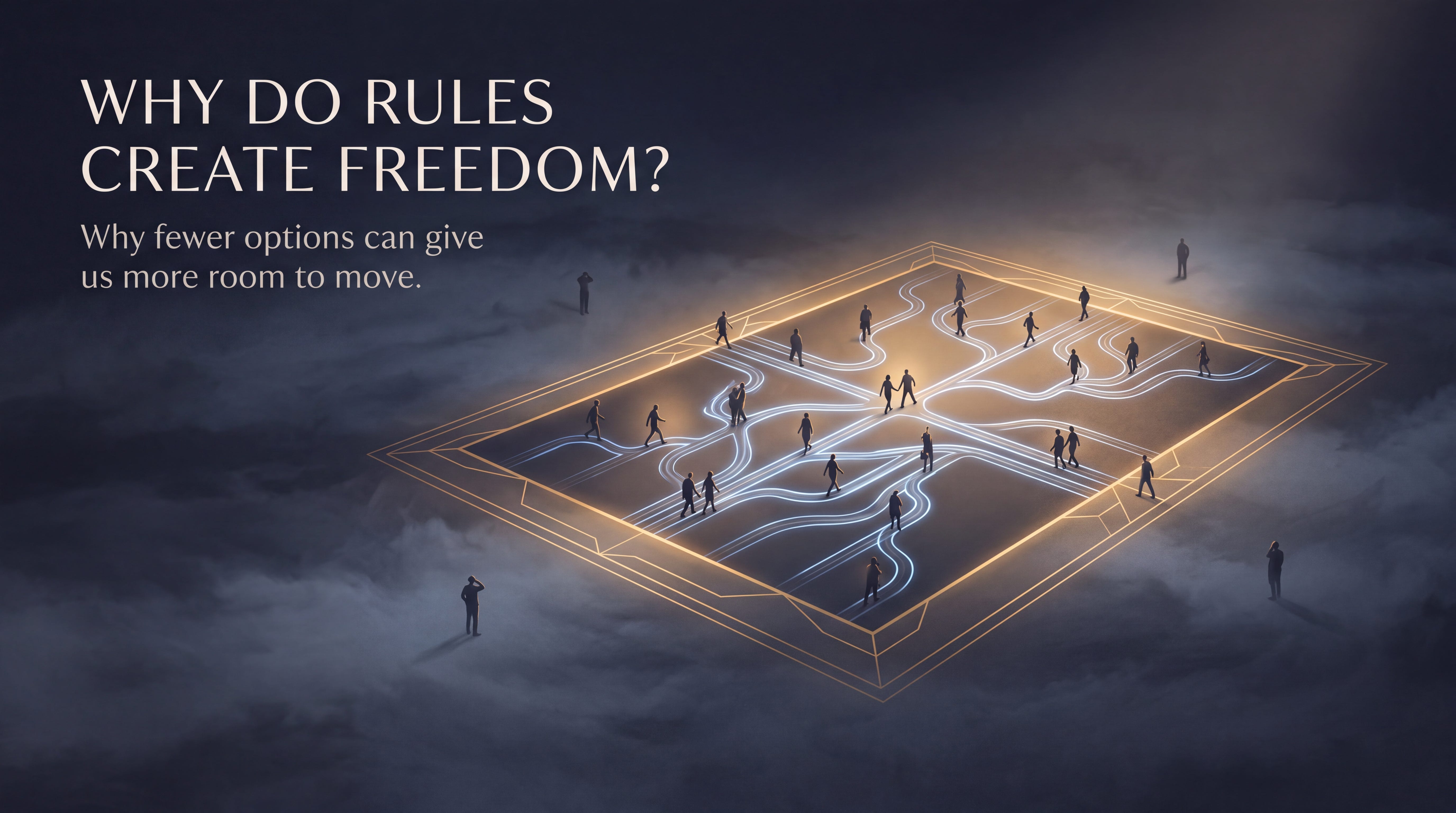
Freedom sounds like having as many options as possible. Remove the rules, open every door, leave every choice available, and surely we become more free.
Except that many of the places where humans feel most creative work almost exactly the other way around.
Games become interesting because most moves are forbidden. Music gets structure from rhythm, key, and form. Poetry can become more inventive when it has a meter or a rhyme scheme to push against. Programming interfaces become useful by refusing almost everything they could theoretically allow. Languages work because words and grammar constrain what can mean what. Even good design often begins by narrowing the problem.
So why can fewer possibilities sometimes produce more freedom?
This episode explores creativity under constraint, game design, improvisation, architecture, language, programming, and the strange difference between having unlimited options and having a space in which meaningful choices can actually be made.
Along the way, it considers a deeper possibility: perhaps a rule does more than remove options. A stable constraint can become shared ground, eliminating choices that no longer need to be reconsidered while leaving a structured field of possibilities open underneath it.
In that sense, freedom may not be the absence of constraint at all. The more interesting question may be which constraints remove possibility, and which constraints create somewhere for possibility to grow.
If you want to follow the framework behind this Bit, you can start here. The Index maps the larger set of ideas and how they connect.


